I have vivid memories of my own departure from Germany with the Kindertransport on July 25, 1929, almost one month before the outbreak of World War II.
THE WRITER, at the age of three, walks with his parents. (photo credit: Courtesy Walter Bingham)
Last month, we commemorated Kristallnacht, “the night of the broken glass,” which took place during November 9-10, 1938. It was the major Nazi pogrom targeting Jews, which marked the beginning of the Holocaust.
The pogrom targeted all synagogues in Germany, Austria, and the already Nazi-occupied western Czechoslovakia (the Sudetenland), which were burned down. The holy Torah scrolls were desecrated and were valuables stolen. Some 30,000 Jewish men were taken to concentration camps and thousands of Jewish homes and businesses were destroyed or damaged.
The fire brigade was there, not to douse the flames, but to cool down and protect neighboring German-owned property. Crowds of Germans stood by and watched it happen. At about 8 a.m., I arrived at my classroom, which was in the destroyed synagogue building. I saw it all.
Fast forward: Immediately following this “sign of things to come,” Jewish community leaders appealed to Jewish charitable organizations in the UK with the urgent call: “Please do something to save our children (kinder).”
Miraculously, the British government responded positively to the British Jewish leadership’s request. With the help of Jewish philanthropists, they arranged for 10,000 children to be admitted to the UK. At that time, the Nazi policy was to expel the Jews, as the “Final Solution” had yet to be formulated and implemented. The British immediately agreed to take the youngsters and the necessary arrangements were put in motion.
During the next eight months, regular transports, originating in Germany, Austria, and the Sudetenland, took place. Unfortunately, on September 1, 1939, World War II broke out and everything came to an abrupt stop. The last group of children who left Prague on September 3 were turned back and never heard from again.
I owe Nicholas Winton my life – today I’ll be thinking of him
Posted on December 3, 2024
It was 2008 and my family and I were at the premiere of the film The Power of Good: Nicholas Winton.
The documentary is about the young English stockbroker who, between March and August 1939, rescued 669 refugee children, mostly Jewish, whose families had fled persecution by Nazi Germany in Czechoslovakia.
The director, Matej Minac, had previously spent a day interviewing my mother, Liesl Silverstone (née Fischmann), my brother Rob, and myself – because my mother was one of the 669 children Sir Nicholas Winton had saved.
She’d told him abouther journey from Prague to London and her early months in the UK – and now, watching the film with my mum was incredibly moving, particularly the scenes where the children depart from the station, leaving their families behind.
After the screening was over, Nicholas Winton was introduced by journalist and presenter Esther Rantzen,to great acclaim.
As Nicholas stepped out on stage, I felt hugely indebted to him.
Rantzen then asked for all the Kindertransport people present to stand. Around 20 – including my mother – stood up, most of them now elderly, to a tremendous round of applause.
Rantzen then asked all the people who wouldn’t have been there without Winton to stand. Half of us in the audience got to our feet.
It was incredibly moving for me to share that experience with my mother, brother, children and grandchildren, who were all there with me.
I realised then that Nicholas Winton had saved us all. I wouldn’t be here had it not been for him. That image of half the room – including my family – standing is one I will never forget.
(L-R) Danny, his mother Liesl and his brother Rob (Picture: Danny Silverstone)
My mother, Liesl, was born in Teplice, Czechoslovakia, in 1927 to an upper-middle class Jewish family. Her father and grandfather had established a large glass factory in and around that town.
While her mother, Friedl, came from a rural Jewish background, my mum grew up in a very bourgeois lifestyle. It seems she had a happy childhood together with her brother Heinz.
When the Germans invaded the Sudetenland in 1938, my mother’s parents decided to move to Prague, where the kids were enrolled in a school and my grandfather retrained as a watchmaker following their relocation.
My grandparents had numerous appointments with embassies seeking visas, but any attempts to secure visas out of Czechoslovakia for the whole family were unsuccessful – and once war was declared, their focus shifted to surviving as a family unit.
A telegram from Danny’s grandmother to his mother (Picture: Danny Silverstone)
This followed the complete annexation of Czechoslovakia in 1939, when Czech Jews were subject to growing restrictions on what they could do, with whom they could associate and where they could live.
Living conditions in Prague became increasingly bad – but, until their forced arrival at Terezin, a concentration camp 30 miles north of Prague, in 1942, my grandparents had no idea what awaited them.
For now, they just knew they had to get the children out if they possibly could – and this is how my grandparents came across Nicholas Winton.
I have no idea how they actually met him, but it was most likely through word of mouth via the Jewish community in Prague.
The Kindertransport scheme covered the evacuation of 10,000 child refugees from Nazi-controlled Europe to Britain. Nicholas’ focus was on saving Jewish children in Czechoslovakia.
Nicholas Winton Street – Czech Street Named After British Hero
Posted on October 22, 2024
Philanthropist, humanitarian and British hero, Sir Nicholas Winton, has been recognised for his honourable actions during the Holocaust through the naming of a new Czech street, along with a sizeable mural.
The street has been unveiled as a memorial for Winton to remember his transportation of 669 Jewish Czech children to Britain, saving them from the horrors of concentration camps.
The liberal-minded, British stockbroker was determined to help Jewish children after receiving a letter from fellow labour socialist, Martin Blake. The letter urged Winton to help refuge children from Prague to spare them from the concentration camps.
By writing to the British embassy and organising asylum shelters, Winton arranged eight trains to transport children to Britain to live with either their family members or, for the majority, complete strangers. Throughout the 1930s and 1940s, Winton saved 669 children through this initiative, known as Kindertransport, sending Jewish children from Czechoslovakia to Britain.
Winton was knighted in 2003 and passed away in 2015.
On September 3rd 2024, a ceremony was held in honour of the new street, coinciding with the 85th anniversary of the final Kindertransport journey. The location of the street is next to Bubny Station, where 50,000 Jews were victims to the passage leading to concentration camps. This street serves as a memorial to those who mandatorily boarded these trains and perished under Nazi rule.
The new street now links the East and West districts together. The British Ambassador to the Czech Republic commented on this, saying the connections of the two districts is a ‘beautiful symbolic aspect.’
Four of the children, who were saved by Winton, attended the ceremony. Lady Milena Grenfell-Baines is a 94-year-old survivor who speaks out about Winton’s work. She told the BBC that ‘there is a big generation- thanks to him- alive today.’
Lady Baines further mentions the Association of Jewish Refugees (AJR), who attended the ceremony to ‘pay tribute to our saviour and a great sadness for those we had to leave behind.’
AJR is a welfare service providing support to the survivors of the Holocaust. AJR worked in support of Prague 7 municipal district and many other charities (specifically Memorial of Silence and The Federation of Jewish Communities in the Czech Republic) to name the street and to honour Sir Nicholas Winton.
‘For the Child’ exhibit tells Kindertransport story for adults and children
Posted on October 8, 2024
The exhibit tells heroic stories of simple people, which can ultimately inspire students’
Image of Herbert Kaye’s suitcase from ‘For the Child’ exhibition. (Photo courtesy of Milli Segal)
An exhibit sure to prompt robust intergenerational dialogue, “For the Child – The Story of the Kindertransport,” began its Pittsburgh tour on Sept. 22 at Rodef Shalom Congregation. It will make its way to several educational centers and community institutions with lessons about the historic Kindertransport and present-day responsibilities.
Between 1938 and 1940, approximately 10,000 refugee children — mostly Jewish — were brought to Great Britain from Nazi Germany via the Kindertransport.
“For the Child” marks 85 years since the end of the Kindertransport by detailing participants’ “personal stories,” Ellen Resnek, educational programs and outreach manager at Classrooms Without Borders, said.
Artists Rosie Potter and Patricia Ayre developed the exhibition between 2000 and 2003 following the requests of several Kindertransport participants.
Potter and Ayre created 23 panels with each showing a photo of an original suitcase and the objects its young owner transported. Inside some suitcases are family photos. Inside other suitcases are a prayer book, doll or brush. Written above each panel is a fragment of text relating to a suitcase’s contents.
Milli Segal has curated and owned the exhibition for nearly 18 years.
Speaking with the Chronicle by phone from Vienna, Segal explained that the exhibition offers a window into “the Kinder.”
Their belongings were no different than what many children might pack today if they were leaving everything they knew, she said. These items are “the remembrance of home.”
Image of Jochewet Heiden’s suitcase from ‘For the Child’ exhibition. (Photo courtesy of Milli Segal)
On Sept. 22, the Holocaust Center of Pittsburgh joined CWB to cosponsor an opening reception for the exhibition.
Emily Loeb, the Holocaust Center’s director of programs and education, said the two organizations are looking forward to “getting the exhibition into schools.”
Seeing these panels is important because “people think about children differently,” Loeb said. “For a parent to have to think about sending their child elsewhere, to another country, is almost unfathomable. The Kindertransport story really resonates and connects with people in a deep way.”
Local institutions including Seneca Valley School District, Allegheny Intermediate Unit, Rodef Shalom, Community Day School and the Holocaust Center, already have agreed to showcase the exhibition during its Pittsburgh stay, Resnek said.
Casey Weiss, Community Day’s head of school, said that CDS is partnering with CWB to bring the exhibition to the Jewish day school.
“This is an incredibly important initiative that we are absolutely elated to collaborate on,” Weiss said.
Moving Holocaust exhibit at Seneca Valley tells story of children rescued from Nazis
Posted on September 22, 2024
Sam Luszic, Anna Gotlinsky and Caden Gekeler, all sophomores, view a few of the 30 panels lining the LIGHT Center at Seneca Valley Intermediate High School. The exhibit, titled “For the Child: Stories of the Kindertransport,” included 30 panels depicting the items Jewish children packed in their suitcases when they were saved from Nazi persecution by being transported to Great Britain. Seneca Valley is the only school district to receive the exhibit, which normally goes to synagogues or anti-hate events.
JACKSON TWP — The 30 panels in the “For the Child: Stories of the Kindertransport” exhibit at Seneca Valley Intermediate High School demonstrate the determination of Jewish children to retain some connection to their happy home life before Hitler’s regime of hate destroyed their families.
The exhibit, which was open to the students and staff from Sept. 10 to 18 in the school’s LIGHT Center, included photos on large panels of the items children packed in their suitcases for the trip to Great Britain, where they would be away from Nazi persecution.
The humanitarian effort Kindertransport saved almost 10,000 mostly Jewish children between 1938 and 1940 as Hitler’s anti-Jewish rhetoric increased. The transports were planned by those in Germany’s Jewish communities, and child welfare organizations in Great Britain arranged for the children’s care, education and eventual emigration to Britain.
From Here On, Greenwich & Docklands International Festival
Posted on September 10, 2024
An exhilarating, emotive performance about displaced children both historically and in a contemporary context, that invites individuals to actively combat anti-refugee policies.
As part of the Greenwich & Docklands International Festival, Good Chance and Gecko Theatre’s From Here On marks 85 years since the Kindertransport saved thousands of mostly Jewish children from Nazi-occupied Europe. Working in conjunction with Gecko’s professional company 40 young people from around the world perform an exhilarating piece that uses movement, dance, music, and performative storytelling to consider both historical and contemporary issues around the displacement of children.
The Kindertransport was initiated by individuals and charity organisations rather than governments, and this production itself invites social connection that speaks to these origins. It is free to attend, open to all, and non-ticketed. It is also performed exposed to the elements (but under a roof) at Liverpool Street Exchange, where the large company embrace the open space, filling it with resonant music and expansive ensemble work.
Intricately directed by Amit Lahav, this vibrant, enthusiastic and physical performance is not simply a retelling of the story of the Kindertransport, but a complex recognition of the ongoing displacement of young people across the world today. Using simple props such as suitcases, musical instruments, domestic furniture and symbolic costume, the show enacts the experiences of children who are victims of migration, often sent unaccompanied to seek sanctuary by desperate families.
The story has a non-linear quality, intermingling times, countries and cultures in a whirling representation of an unremittingly present problem. From the very start, international boundaries are deconstructed, as languages cross over and similar events occur across cultures: from Africa to the Middle East to Asia to Europe, children around the globe are forced from their homes by war and political power struggles. The diverse casting of performers of many ages and backgrounds works beautifully to underscore this key message.
Slick, considered choreography visually demonstrates how people can be brought together to help or hinder refugees, but also how people can be separated, becoming isolated and vulnerable. The ensemble vividly portrays the human pressures that disrupt domestic lives, moving in synchronicity to show the menacing danger of anti-refugee pressures from the masses, then dividing up to relate the pain of families endangered by circumstances beyond their control. Individuals become objectified and dehumanised as they are labelled ‘refugee’, with the Kindertransport number tag a reminder of the sheer quantity of people who still undergo this process to this day. Yet we’re simultaneously reminded of the urgent need for play and community, which give value and support in difficult circumstances. The performers’ movements are fluid and beautifully descriptive, telling poignant, affecting tales without words, and they are accompanied by highly atmospheric music and sound throughout.
From Here On not only draws an emotive, tangible understanding of the humanity of refugees but it also demonstrates how the compassion of individuals and communities has the power to make real change and help them. Supporting this, the production additionally calls out to audiences to add their names to Safe Passage International‘s call for Safe Routes, which seeks to combat the impact of anti-refugee policies around the world and make asylum systems more humane for unaccompanied children. Their message: as with the origins of the Kindertransport, acts of compassion from every individual can make a big difference and it’s up to each of us to do the right thing for those who cannot help themselves.
The Kindertransport Statues Of Liverpool Street Station
Posted on September 9, 2024
Image: Matt Brown
85 years ago, Liverpool Street station welcomed hundreds of refugee children.
It’s not unusual to find a group of kids hanging around outside McDonald’s. These five are a bit different, however. They are dressed in the clothing of another age, laden down not with Roblox rucksacks, but traditional valises and satchels. These five represent the many hundreds of children who arrived at the station in the late 1930s. They were refugees of the Nazi regime, and Londoners welcomed them with open arms.
The Kindertransport (German for “Children’s transport”) rescued some 10,000 children from Germany and Nazi-occupied Europe, between November 1938 and September 1939. Most of them were Jewish. Parents could not accompany the children, and nobody over the age of 17 was eligible. It must have been terrifying.
The evacuation was done with the support of the British government, who waived visa requirements. Numerous organisations and individuals — notably Sir Nicholas Winton — worked hard to set up the transport, raise funds and find foster homes for the children.
Most of the young refugees arrived by boat in Harwich, Essex. From there, many were sent to converted holiday camps. Others boarded trains for London. It was here, in Liverpool Street station, that they were first introduced to foster parents. The evacuations continued right up to the eve of the second world war, but which point some 10,000 children had been saved.
The experience could be deeply traumatic. Some children were too young to fully understand why they had been separated from their parents. Many would never be reunited. Then they had to settle in an unfamiliar country, living with strangers who often could not speak their language.
Liverpool Street’s Kindertransport Statues
Image: Matt Brown
Liverpool Street’s role in this mass evacuation is commemorated by two sculptures. The one shown above is called Kindertransport – The Arrival. It depicts a group of five children, standing symbolically on a railway track, which carries the names of the cities from which they fled. This powerful sculpture was created by Frank Meisler and Arie Ovadia. Meisler was himself among the children evacuated from Gdańsk and transported to Liverpool Street. It stands in what is now named Hope Square, just outside the Liverpool Street entrance.
Image: Matt Brown
The second sculpture, down on the main concourse, is called Fur das Kind – Displaced. It shows two forlorn children waiting around with their luggage. The base carries a dedication to The Religious Society of Friends (The Quakers) who played an important role in arranging the Kindertransport.
This sculpture, by Flor Kent, is itself displaced. It originally stood up in Hope Square from 2003 to 2006, where the figures were accompanied by a giant glass suitcase filled with original objects from Kindertransport children. This proved unsuitable for an outdoor location. In 2006, it was taken apart, and reconfigured. Nicholas Winton himself re-dedicated the sculpture in 2011, when it was unveiled on the concourse. The objects from the glass suitcase are now in the Imperial War Museum.
We should note in closing that children were evacuated to other countries — including France, Belgium, the Netherlands, Sweden and Denmark — though in smaller numbers. Other memorials can be found along the Kindertransport routes, including at Harwich, Gdańsk, Berlin, Prague, Hamburg and Hook of Holland.
Liverpool Street’s statues are all too often used as ad hoc seating or for the lazy disposal of coffee cups. But they deserve our attention and respect. These are memorials to kindness, humanity and altruism, qualities we should remember today when considering the needs of refugees.
Dance performance outside Liverpool Street Station to mark 85 years since Kindertransport
Posted on September 6, 2024
A new dance-theatre production outside Liverpool Street Station this weekend will mark 85 years since the UK welcomed nearly 10,000 Jewish children on the Kindertransport.
Billed as “a powerful exploration of displacement, movement and being forced to find a new home”, the 35-minute show From Here On, by the theatre company Good Chance, brings history to life alongside global stories of children seeking safety now.
A spokesperson for Good Chance, said: “The fact that 2024 marks 85 years since the last train arrived at Liverpool Street Station, we realised that this is one of the last remaining anniversaries in which some of the Kinder will still be able to say: this happened to me, I was there.”
They added: “In this time of unprecedented global conflict, of increasing antisemitism, Islamophobia and anti-immigration sentiment, the lessons we’ve already learnt from the past are being dramatically forgotten. It feels more important than ever to mark this courageous people’s act of safe passage and to understand what it can teach us about forced displacement and routes to safety now.”
t was important to us from the very beginning that young people particularly from Jewish and refugee/asylum seeking backgrounds were part of the cast, as they and their families have the lived experience of many of the stories being depicted,” said the spokesperson. “We’re so excited to be bringing these young people together to tell stories of safe passage through the shows – and equally excited that we’ll then be working with them to become changemakers in their own communities through our legacy programme to co-create their own talks and events.”
Directed by Israeli-born Amit Lahav, Gecko’s artistic director, the performers in the show use movement, both illustrative and more abstract, and emotion to tell the story. Instead of dialogue typically associated with theatre, audiences can expect to hear multiple languages and a “deeply evocative” soundtrack. This the creators hope will draw those from all backgrounds and nationalities to find a personal connection to the piece.
The company has previously told stories of displacement in large-scale theatre spaces and public outdoor settings in The Jungle and The Walk with Amal.
From Here On is on Friday 6 and Sunday 8 September, at 11am, 1.15pm, 3.30pm and 5.40pm.
From Here On musical performance at Liverpool Street Station
Posted on September 3, 2024
From Here On brings history to life alongside global contemporary stories of children seeking sanctuary now. Marking 85 years since the Kindertransport saved 10,000 Jewish children from Nazi-occupied Europe, this show is a powerful exploration of displacement, movement and being forced to find a new home.
40 young people from around the world take to the stage alongside Gecko’s professional ensemble in an exciting large-scale production performed outside Liverpool Street Station, directed by Amit Lahav.
From Good Chance, creators of The Walk with Little Amal, and Gecko, who brought you Kin, From Here On is an artistic call for empathy, hope and unity. A thought-provoking piece that crosses borders, cultures and generations, told to inspire new acts of solidarity in partnership with Safe Passage International and build a safer future for all young people forced to flee their homes.
Mr Farago was taken to Brussels on Kindertransport trains, which took children out of Nazi-controlled areas to safer territory
A man who came to England during World War Two said that he can remember the moment that, “Hitler walked straight through the middle of Vienna during my ninth birthday party.”
John Farago, 95, who now lives in Deal, Kent, said that members of his Jewish family who he was living with in Austria were “apprehensive and fearful for their lives”.
Mr Farago was taken to Brussels in Belgium on Kindertransport trains, which took children out of Nazi-controlled areas and into safer territory.
He lived with a family in Brussels but came to Folkestone in 1940 and then moved to Amersham, in Buckinghamshire, with members of his family.
Speaking to BBC South East ahead of the 85th anniversary of the Kindertransport, Mr Farago said: “Most people were cheering for Hitler when he marched in. The people in the street were shouting for joy.
“I only learnt later in my life members of my family took their lives on the same day.”
He added that in November of 1938, during Kristallnacht in Vienna, people were fighting against Jews, and some were killed.
It was after Kristallnacht that the British government agreed that some Jewish children under the age of 17 could temporarily come to Britain to safety.
The first Kindertransport from Berlin in Germany departed for the UK on 1 December 1938. Over the coming nine months, thousands were rescued.
The last Kindertransport train to leave Germany departed from Berlin on 1 September 1939 – the same day that Germany invaded Poland. Britain declared war on Germany two days later.
‘I was lucky’
Mr Farago said: “I always felt I was lucky because I escaped. I was lucky because my parents escaped.
“My grandparents stayed behind in Vienna but then married a Hungarian, so she moved there.
“Some members of my family survived, but one of my father’s brothers was lost.”
Kindertransport refugees given warm reception at Mansion House
Posted on July 30, 2024
Eighty-five years since the Kindertransport brought the youngest victims of Nazi terror to safety in Great Britain, some of the former child refugees have been hosted by the Lord Mayor and Lady Mayoress of the City of London – just a stone’s throw from their arrival point.
Eight refugees and their descendants were welcomed to Mansion House, a short walk from Liverpool Street Station, which was where many of the Kinder had met their foster parents for the very first time.
Two of the Kinder, Renate Collins, 91, and Alexandra Greensted, 92, were rescued by the late Sir Nicholas Winton, who became famous for being one of the key organisers of the rescue of 669 children from Nazi-occupied Czechoslovakia, recenty depicted in the film ‘One Life‘.
The Lady Mayoress, Elisabeth Mainelli addressing the Kinder at Mansion House (Photo: Adam Soller Photography)
Addressing the Kinder, the Lady Mayoress, Elisabeth Mainelli, said: “From its earliest beginnings the City of London has welcomed people of all faiths, beliefs, and nationalities – many of whom were fleeing persecution at home. The City played an important role in the Kindertransport story. Children arrived at Liverpool Street Station to begin their new lives in the UK.”
She later said it had been “an honour” to host Kinder and their families at the mayoral residence on the 85th anniversary year of the Kindertransport and that it had been “an opportunity to remember their bravery and celebrate their lives and legacies We are proud of the City’s Jewish heritage.”
Kinder Alexandra Greensted (left) and Maria Ault (Photos: Adam Soller Photography)
The Kindertransport was a unique humanitarian mission through which approximately 10,000 children, the majority of whom were Jewish, were rescued from Nazi-controlled territories, during the nine months prior to the outbreak of World War Two.
Danny Kalman, Kindertransport chair at the Association of Jewish Refugees (AJR), which arranged the event, said: “We are thankful to the Lord Mayor and Lady Mayoress for hosting the Kinder today. It seems fitting that only a short walk from here, at Liverpool Street Station, so many of those children started new lives, after unimaginable journeys against the backdrop of oppression, displacement, and war.
“It’s testament to their parents’ brave decision to send their precious offspring into the unknown, for a chance of freedom, that we see three generations of descendants here today. A chink of light in one of the darkest chapters in history and emblematic of AJR’s growing next generation membership, who enrol with us to celebrate and preserve their family heritage.”
Kind Renate Collins (centre) with her family at Mansion House (Photo: Adam Soller Photography)
As part of the visit, the Kinder were treated to a guided tour of Mansion House and learnt about The Freedom of the City. They also looked at memorabilia relating to Sir Nicholas Winton’s Freedom and discovered more about the history of Jewish migration in the City of London.
After Kristallnacht, the Night of Broken Glass, the idea to rescue children from the Nazis and bring them to Britain is proposed to the British Government by two of World Jewish Relief’s founders, alongside other organisations, and a delegation of prominent British Jews.
Following a 45-minute appeal by the delegation directly to the Prime Minister, Neville Chamberlain, the British Government agrees to permit temporary admission of vulnerable Jewish children who were at risk of Nazi persecution, under the financial guarantee of the UK Jewish community.
Thanks to the overwhelming generosity of the UK Jewish community, World Jewish Relief (then the Central British Fund) raises funds to cover the cost of travel for each of these children.
Within three weeks of Kristallnacht, the first 200 of these children begin their journey from Berlin to the UK. Most of these unaccompanied children travelled to Liverpool Street Station, meeting their volunteer foster parents for the first time, heralding the start of a new life.
Between December 1938 and September 1939, almost 10,000 children were brought to safety through the Kindertransport
KINDERTRANSPORT – RESCUING CHILDREN ON THE BRINK OF WAR AT ILLINOIS HOLOCAUST MUSEUM
Posted on June 7, 2024
SPECIAL EXHIBITIONS GALLERY
Through November 17, 2024
Kindertransport – Rescuing Children on the Brink of War showcases the astonishing rescue effort that, in only nine months, brought thousands of unaccompanied children from Nazi Europe to the United Kingdom. Through personal artifacts, stories, and firsthand testimony, those who lived through the “Kindertransport” program tell its history.The exhibition’s thoughtful, artistic design draws visitors in and features 75 personal artifacts, including items from Illinois Holocaust Museum’s collection, Survivor testimonies, and quotes that chart the heart-wrenching decisions parents made in sending their children away to safety. Kindertransport serves as a powerful testament to both the resilience of the human spirit and the importance of honoring the legacy of those who endured unimaginable suffering.
Kindertransport – Rescuing Children on the Brink of War was created and organized by Yeshiva University Museum and the Leo Baeck Institute – New York | Berlin.
Kindertransport exhibit opens eyes at Illinois Holocaust Museum
Posted on June 4, 2024
(click link for video)
The Illinois Holocaust Museum has a new exhibit about a program during World War II that saved thousands of childrens’ lives. It was called the “Kindertransport.” FOX 32’s Natalie Bomke talks with a Chicagoan who said that transport saved his life.
Son of Holocaust survivor returns to Austrian school which expelled his father for being Jewish
Posted on May 24, 2024
Michael Bibring continues to share the testimony of his late father Harry Bibring who fled the Nazis on the Kindertransport
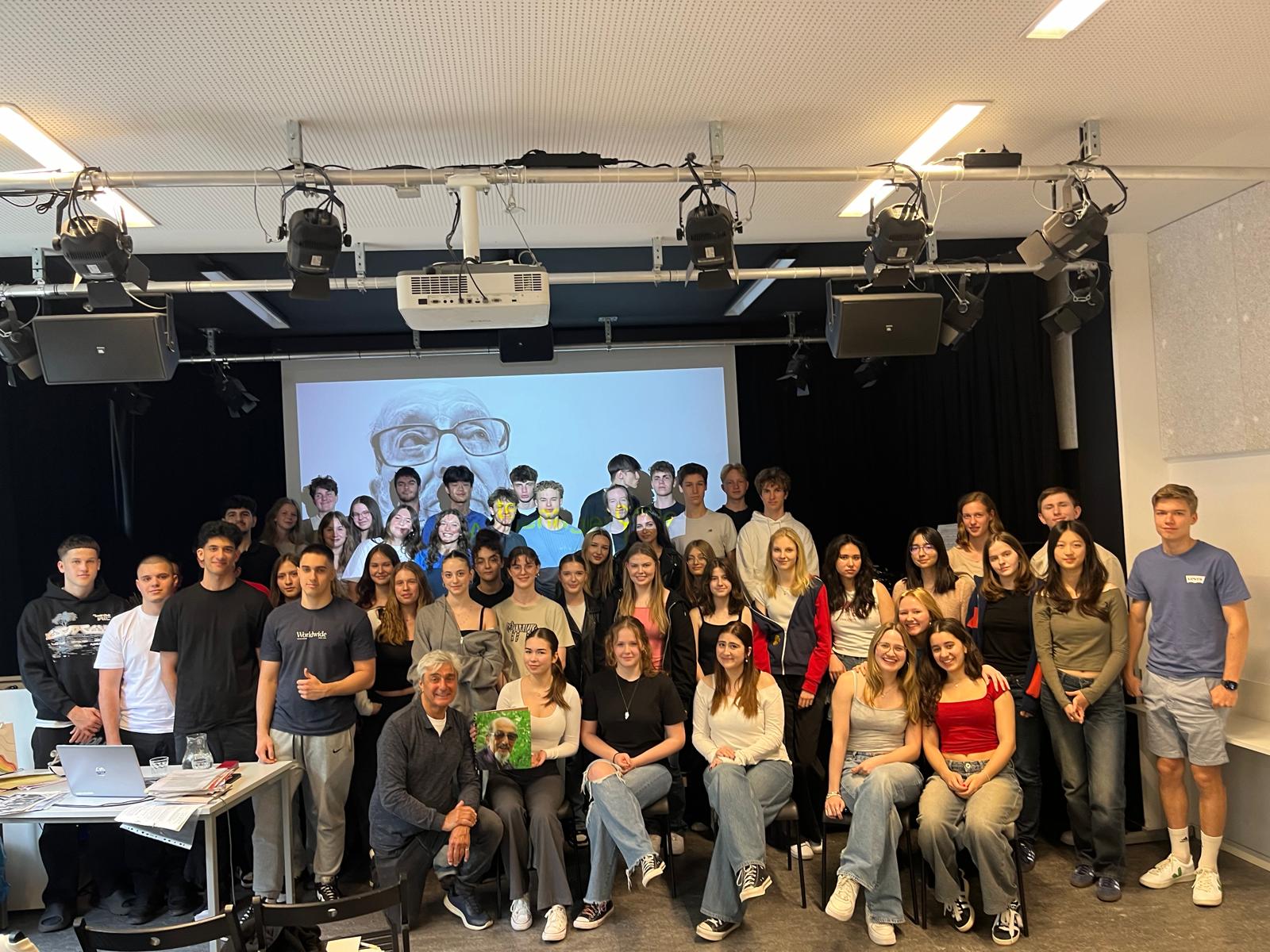
Michael-Bibring-with-students-from-the-school. Pic: HET
More than 70 students from a grammar school in Austria heard from the son of Holocaust survivor and former student of the school, the late Harry Bibring.
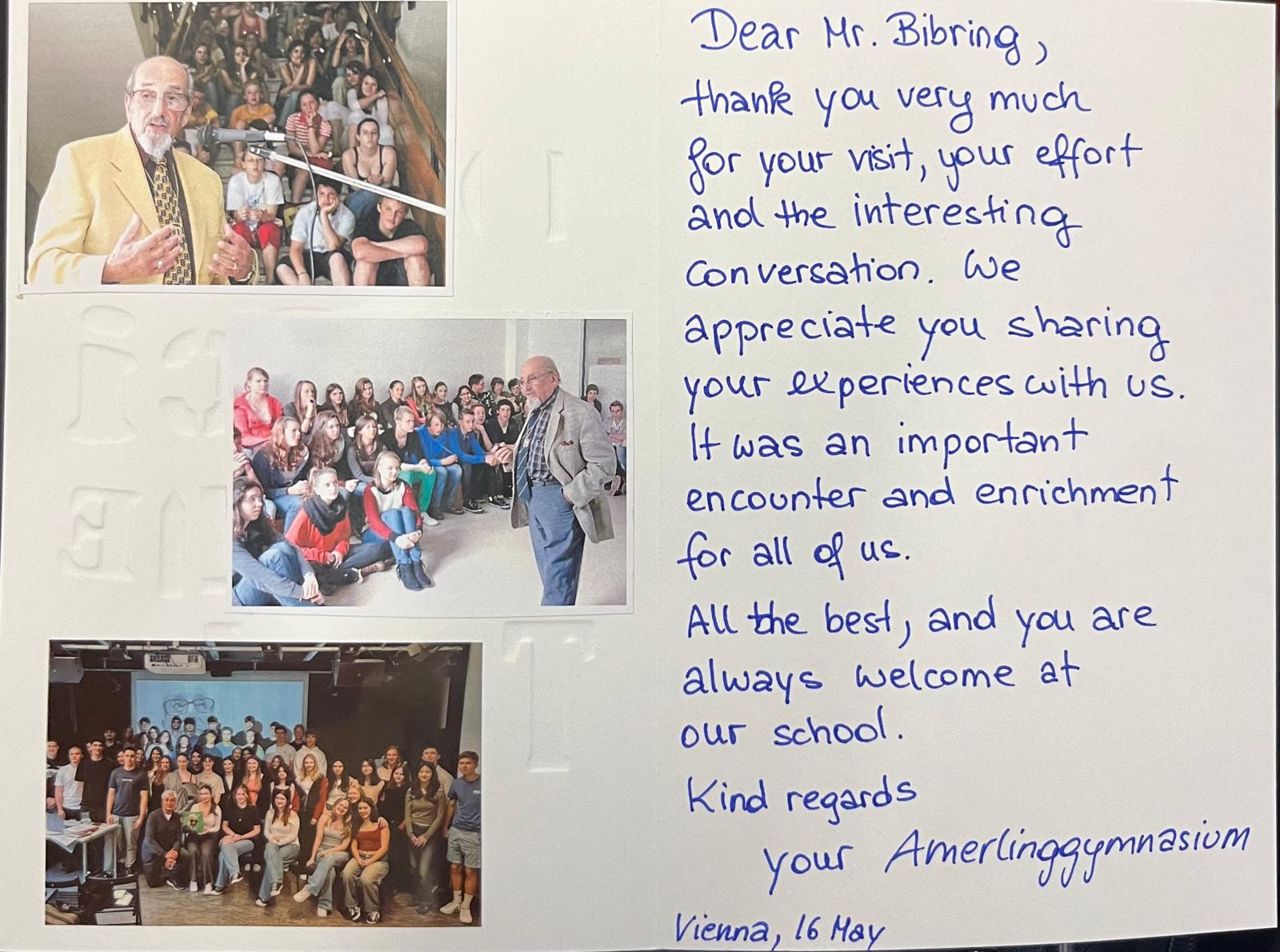
Amerling Gymnasium (grammar) school in Vienna met Michael Bibring, who continues to share his father’s testimony with schools through the Holocaust Educational Trust’s (HET) outreach programme, last week.
Harry, who passed away in 2019, was expelled from the school in April 1938 at the age of 12, following the German annexation of Austria, known as the Anschluss.
Ostracized by his non-Jewish friends, he was forced to transfer to a basic secondary school designated to accommodate Jewish children.
Harry fled Nazi occupation and travelled to the UK on the Kindertransport in 1939. He dedicated the later years of his life to sharing his testimony.
In 2005, Harry, who lost both his parents in the Holocaust, returned to the school for the first time to speak to the students and returned a year later to unveil a memorial to remember all the former Jewish students who were expelled in 1938. The fates of many of them remain unknown.
Michael Bribing said: “This was an extraordinary event. To go back to the school that dad was expelled from and speak to their students about the horrors that led to that expulsion was so rewarding and emotional. Even more so because my dad had spoken at that school many times and students who had listened to him came in numbers when we unveiled the Stolpersteine five years ago.
“HET, my dad and I, were and are, firm believers in education being so important in fighting prejudice and intolerance and this whole experience underlined the importance of that in a way I found so moving – hopefully there will be opportunities to do it again”
Following the testimony, Michael was presented with a copy of his father’s school report from 1937.
Over 70 family members of Kindertransport children visit Harwich
Posted on May 21, 2024
FAMILY members of Jewish child refugees who arrived in the UK through the Harwich port during the Kindertransport movement in the lead up to the Second World War were welcomed to the town this week.
The Kindertransport scheme saw the United Kingdom take in nearly 10,000 children of mostly Jewish origin from Germany in the nine months leading up to the war.
The vast majority of the rescued children arrived at Harwich unaccompanied by their parents – most of whom died in the Holocaust.
The first Kindertransport children arrived at Harwich on December 2 1938, with some taken to London and others taken to local holiday camps such as Dovercourt Bay.
Nearly 2,000 of the mostly Jewish children spent their first weeks at the Dovercourt holiday camp.
72 family members of the Kindertransport visited Harwich this week for a day-event organised by the Association of Jewish Refugees (AJR) and the Kindertransport Association (KTA), assisted by the Harwich Kindertransport Memorial & Learning Trust (HKMLT).
The group visited an exhibition about Leslie Brent who was part of the Kindertransport
The group included 40 Americans and was accompanied by Mike Karp, AJR chief executive, Danny Kalman, chairman of AJR Kindertransport, Susan Harrod, AJR events and outreach manager, and Melissa Hacker, a Kindertransport film maker and editor.
Welcoming the group was HKMLT chairman Debbie Patterson Jones and the HKMLT director and High Steward of Harwich, Sue Daish.
The group visited an exhibition at the Electric Palace about the life of ‘Kindertransportee’ Leslie Brent who arrived on the first transport and stayed at the Dovercourt camp for several weeks.
This was followed by a visit to the memorial statue Safe Haven on Harwich Quay and a traditional lunch of fish and chips at the Pier Hotel.
The group also listened to refugee children’s recollections on the audio bench in the Mayor’s Garden and were invited to the Harwich Museum for an illustrated talk by curator David Whittle about the role of Harwich people in the Kindertransport story.
On behalf of the group, many of whom related very moving family histories, Susan Harrod thanked Debbie Patterson Jones and Sue Daish “for a very interesting, informative visit and successful day out”.
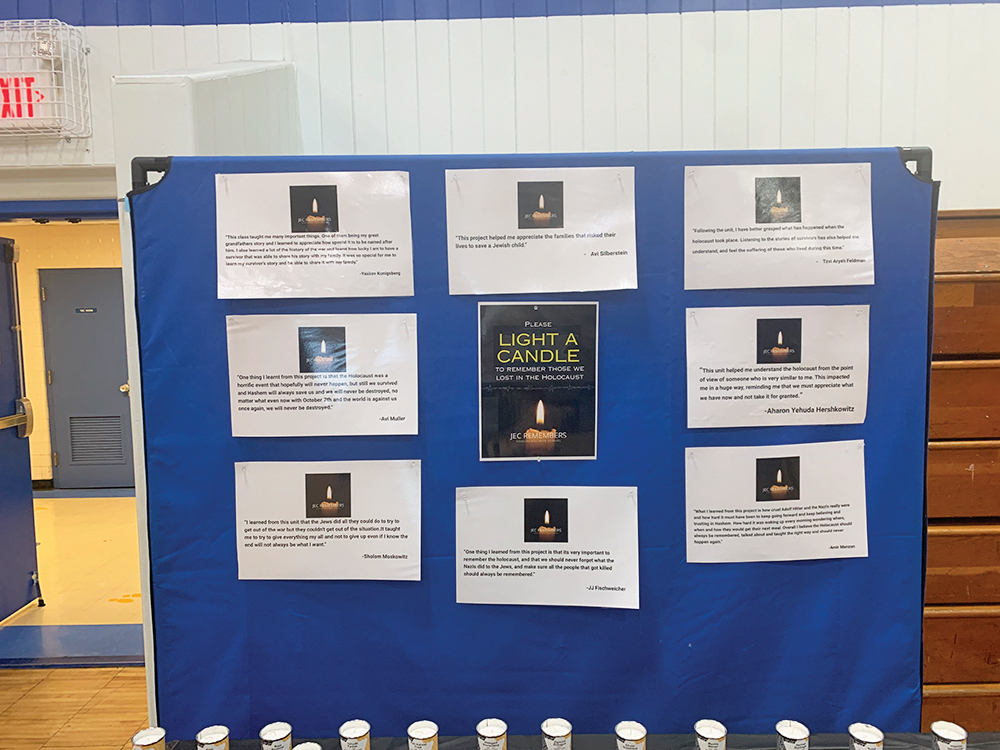
In light of recent current events, Jewish students learning about the Holocaust and its background is more important than ever. This spring, students at JEC Middle School have been deeply immersed in the study of the Holocaust, with each grade focusing on a different aspect.
Sixth grade students focused on individual stories of survivors with whom they had a bond. Unfortunately, none of the students had a living survivor to interview. Those who bore witness to the atrocities of the Holocaust are slowly fading out, placing the burden of remembering on the shoulders of the next generation. The students interviewed the children or grandchildren of survivors instead, learning their incredible stories of survival. They researched the key points of the stories and then used AI technology available on MyHeritage.com to have the survivors’ stories come to life.
Seventh graders learned about the Kindertransport. They then created fictitious stories about a child who went on the Kindertransport. These poignant stories incorporated what they learned about this difficult time with their own creativity. The authors needed to put themselves in the shoes of both the children and their parents who made the desperate decision to send their children to a foreign land. The students created ebooks telling the story of a child on the Kindertransport.
Eighth graders focused on the Jewish communities that were decimated by the Holocaust. The presentations showed what life in these communities was like before the war, relayed what happened to those who lived there and, finally, what life is like there today. The students then tried to imagine what the communities would have looked like had there been no war. To that end, the students used 3D printing technology to design and create a fictional community that they named Ir HaTikvah V’Hazikaron, City of Hope and Remembrance.
This exceptional unit culminated on Yom HaShoah. The students first presented their work to fellow JEC students during the day, and then shared their work with their parents in the evening in a beautiful and meaningful exhibition. The event began with a student-led reading of Tehillim, and then representatives from each grade explained their work. The event space was filled with parents and grandparents, all taking in the moment with pride and tears.
The Kindertransport was a unique humanitarian rescue programme which ran between November 1938 and September 1939. Approximately 10,000 children, the majority of whom were Jewish, were sent from their homes and families in Germany, Austria and Czechoslovakia to Great Britain.
A prime mover in this rescue effort was Nicholas Winton, a British stockbroker, not Jewish, who travelled to Czechoslovakia, saw the plight of Jewish families desperate to save their children even if they could not save themselves from the Nazis, and when he returned to Britain led the campaign to insist that the British government help the children.
He said, “Now I have seen it, I cannot unsee it”. For as long as it was possible through the war, he worked to fulfill the legal requirements of bringing the children to Britain and finding homes and sponsors for them. Thousands are alive today as a result of his efforts.
A recent movie, One Life, tells this moving story.
We can still catch a commemorative concert marking the 85th anniversary of the Kindertransport, even though it took place yesterday. The Leonore Piano Trio, Benjamin Nabarro (violin), Gemma Rosefield (cello) and Tim Horton (piano), are performing a memorial concert programme reflecting the music, culture and heritage of the German, Austrian and Czech roots of the rescued children.
Wigmore Hall, bless them, are keeping this fine concert on their website for 30 days so we can all watch it.
RVCC Institute of Holocaust and Genocide Studies to Hold Virtual Summer Book Series
Posted on May 16, 2024
The Raritan Valley Community College Institute of Holocaust and Genocide Studies will present a virtual Summer Book Series beginning in June. The series, which is free of charge and open to the public, will begin June 14, 2024 with author Lilly Maier. The segments will be held via Zoom webinars and registration is required.
The following programs will feature discussions of extraordinary novels that explore the past:
June 14, 10:00am-11:00am: Arthur and Lilly: The Girl and the Holocaust Survivor by Lilly Maier. What do a 75-year-old, Los Angeles-based rocket engineer and an 11-year-old schoolgirl from Austria have in common? Not much at first glance, but Arthur and Lilly influenced each other’s lives in a fateful way. In 1939, Arthur’s Jewish parents sent their son abroad on a so-called Kindertransport (“children’s transport”), hoping to save him from the Holocaust. The separation is a traumatic experience for the 10 year old. Although he is rescued—after traveling from Austria via France to the United States—his family members are murdered by the Nazis and he never sees them again. Sixty-five years later, during a visit to his parents’ former apartment in Vienna, Austria, Arthur Kern meets 11-year-old Lilly Maier. It’s a decisive encounter for both, one that not only shapes Lilly’s future, but also leads to Arthur receiving a long-lost legacy from his parents. The book offers a moving tale of two lives that fatefully cross paths, as well as insight into a profound Holocaust story: the rescue of hundreds of Jewish children to America on a Kindertransport. To register for the June 14 discussion, visit https://rb.gy/9gd8jw.
July 19, 10:00am-11:00am, The Underground Library by Jennifer Ryan. Set in World War II in London, The Underground Library shares the story of three women: Juliet Lansdown, Bethnal Green Library’s new deputy librarian, discovers that the library isn’t the bustling hub she’s expecting. So, she becomes determined to prove herself and breathe life back into the place. Katie Upwood is thrilled to be working at the library, although she’s only there until she heads off to university in the fall. But after the death of her beau on the front line and amid tumultuous family strife, she finds herself harboring a life-changing secret. And Sofie Baumann, a young Jewish refugee, who came to London on a domestic service visa only to find herself working as a maid for a man who treats her abominably. So, she escapes to the library when she can, finding friendship in the literary community and aid locating her sister, who is still trying to flee occupied Europe. To register for the July 19 book discussion, email michelle.edgar@raritanval.edu.
August 16, 10:00am-11:00am, The House of Eve by Sadeqa Johnson. It’s 1950s Philadelphia, and 15-year-old Ruby Pearsall is on track to become the first in her family to attend college. But a taboo love affair threatens to pull her back into poverty and desperation. Eleanor Quarles arrives in Washington, DC, with ambition and secrets. When she meets the handsome William Pride at Howard University, they fall madly in love. But William hails from one of DC’s elite, wealthy Black families, and his parents don’t let just anyone into their fold. Eleanor hopes that a baby will make her feel at home in William’s family and grant her the life she’s been wanting. But having a baby—and fitting in—is easier said than done. With their stories colliding in the most unexpected of ways, Ruby and Eleanor will both make decisions that shape the trajectory of their lives.To register for the August 16 book discussion, email michelle.edgar@raritanval.edu.